
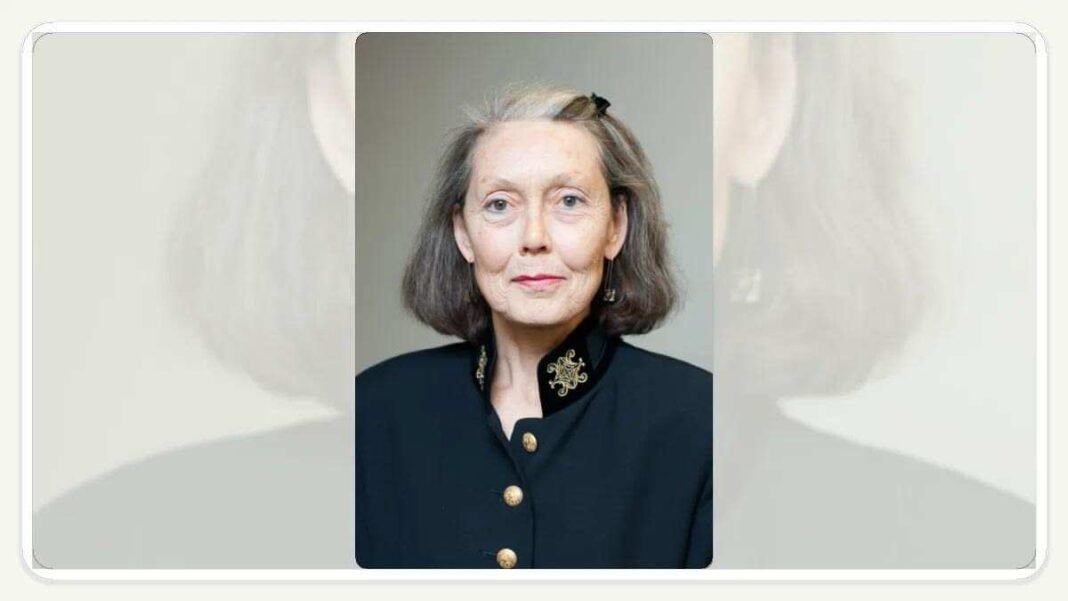
Born in Toronto Canada Carson 76 is a prolific and much-esteemed writer recognized as one of the most original voices of contemporary literature. Her work may encompass poetry prose dramatic dialogue, literary translation and literary criticism. Rather than adhering to the limits of one genre, she joins diverse forms to explore the nature of language memory desire, loss, and human connection.
The Nobel award elevates her to the same celebrated company of writers all over the world who are perhaps best known for transforming the way writers approach their craft. It is an award of 11 million Swedish kronor, based on the current prize amount set by the Nobel Foundation. Carson was reportedly caught off guard by the Swedish Academy’s call while visiting Iceland.
One of Carson’s notable qualities is her engagement with ancient Greek literature. Her academic training in classical languages and literature has shaped a body of work that revisits ancient narratives while addressing questions that continue to resonate with contemporary readers.
Her celebrated 1998 book, Autobiography of Red, is a verse novel based on the Greek myth of Geryon and Herakles. It takes an ancient story and delivers it as a fresh, raw inquiry into the meaning of identity, and love and vulnerability. The blend of myth and emotion has helped Carson reach new readers, outside the poets.
Carson has also brought to life the works of classical Greek writers, including Sappho, whose remaining fragments have intrigued writers and readers for years. Her translation is known for a focus on the texture, doubt, and emotion of the words, rather than mimicking the original wording.
In its citation, the Swedish Academy focused on an aspect of her work that has been much discussed in the translator community: the Swedish Academy has focused on how Carson keeps the art of translation alive in her work. Her translation work shows that ancient texts can be re-read without sacrificing historical context.
Carson’s experiments aren’t confined to poetry and translation. You could start with Float, in 2016, which consisted of 22 different chapbooks that a reader could read in any combination or sequence. The coiled bindings upend what we tend to expect a book to be.
In her 2019 piece “Norma Jeane Baker of Troy”, she combines aspects of Euripides’ Greek tragedy “Helen” and Monroe’s life and mythos. By linking a classical myth and contemporary media, she explores the notion of identity, aesthetics, and performativity of storytelling over time.
These pieces show that she is not afraid to work with literature as a field of endless possibilities. Her writing can be challenging, but at the same time it is a space in which humour, visual games and surprise relationships between sounds and feelings can happen. This has gained her a unique place within contemporary literature.
Apart from the Nobel Prize, Carson has a long record of literary achievement. She has won numerous awards for poetry and has been made a Member of the Order of Canada. Carson has also worked as a professor of classics and literature at institutions in the United States and Canada.
The win is a significant milestone for Canadian literature and for those who love writing that pushes boundaries in both art and culture. It’s also a timely spotlight on poetry and experimental writing as publishers and readers are rapidly adjusting to new realities.