
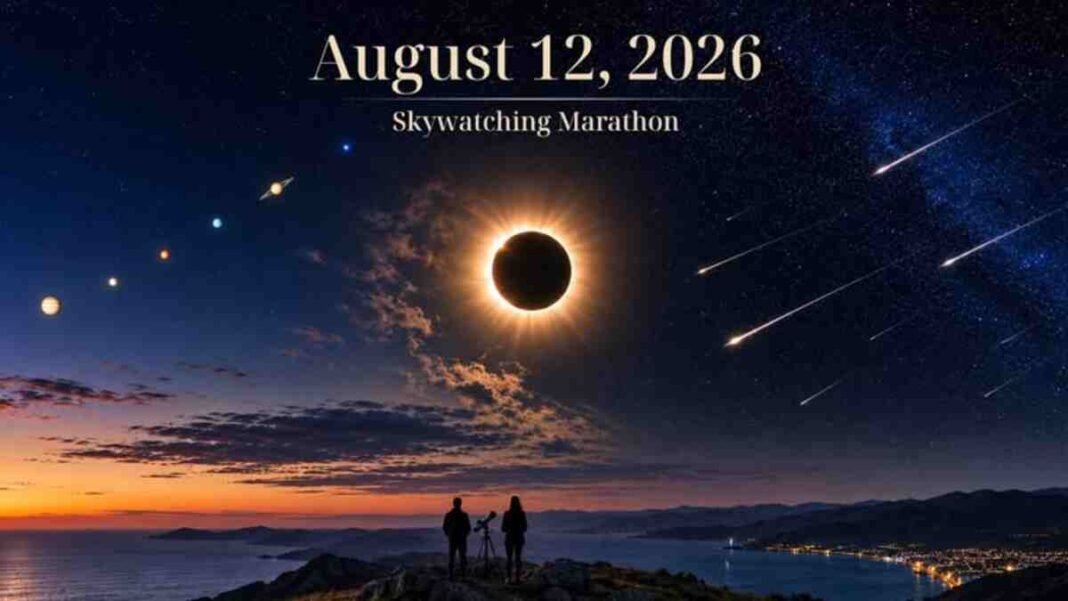
Skywatchers in the Northern Hemisphere are consulting weather reports and packing bags for what could be one of the most memorable nights of this decade. On August 12 a clear blue sky over Greenland, Iceland or northern Spain will be filled by a solar eclipse, while in same night the famous Perseid meteor shower will reach its maximum under perfectly dark, moonless sky. The combination has guides to astronomy, planetariums and local observatories racing to encourage people get ready to take in both events safely. Totality of the eclipse will be confined to a surprisingly narrow track.
Travelers from western Iceland and extending eastward in a swath across northern Spain will experience totality lasting for up to two minutes and eighteen seconds. Totality in Reykjavk will occur in the late afternoon. Even in Spanish cities like Zaragoza, Valencia and Bilbao the eclipse reaches its peak Especially closer to sunset, providing a spectacle not unlike the golden hour of a camera’s flash that is already being named once-in-a-lifetime by photographers.
Aside from the more than ninety percent coverage of the Sun by the Moon in London and Paris, most of Europe as well as parts of northeastern North America will see a deep partial eclipse. The Canadian Maritimes and northern New England will observe the moon taking a noticeable bite out of the solar disk during the afternoon hours. Every guide reminds us: do not stare at a partially eclipsed Sun without special Eclipse glasses or solar filters. Normal sunglasses do not block enough light. Organizations is giving away cheap glasses and has simple instructions on making a pinhole camera for every. School and community centers have special viewing times with trained volunteers.
When the Sun goes down and the eclipse party ends, the other show of the year begins. The Perseids, stray fragments from Comet Swift-Tuttle which has left a trail of broken pieces, will be at their peak during a dark night between August 12th and 13th. Since this peak coincides with the New Moon, than the sky is going to be very dark for the performance. For those in darkness, with the skies cleared of any clouds and rural locations forty and on up to one hundred shooting stars to observe every single hour of the evening including bloated fireballs with glowing trails. The radiant (origin of the shooting star showers) will be just in the Northeastern sky after midnight so the early morning hours to dawn, will have the best service time. Tips include searching for a location that’s missing human light pollution, give 20-30 minutes for the eyes to adapt to the dark, lean backwards and watch the sky, as there is no equipment that will help you in the star viewing.
It seems prearranged. Astronomers say there hasn’t been a witnessed total eclipse on the single best Perseids day in recorded history. The convergence of daytime spectacle and nighttime shower is creating extraordinary public fever. Accommodation along the totality corridor sold out months ago. In Spain, domestic tourism agents scheduled eclipse celebrations complete with bands, presentations and giant screen projections. In Iceland, leaders are running eclipse trips combined with out-of-the-arkarylate night meteor shower viewing in the persistent midnight sun.